Having been to quite a few places in Japan, we were wondering where to go this time our free and easy holiday. We decided to look west and settled on Okayama in the western area of Japan, to the west of Kobe / Osaka.
Overall itinerary Day 1: Arrival into Osaka / Kansai Day 2: Visit to Sake Factory in Kobe Day 3: Trip to Mt. Washuzan and Kojima Jeans Street in Okayama Day 4: Drive to Bitchu Matsuyama Castle Day 5: Stroll in Arashiyama Bamboo Grove in Kyoto Day 6: View tea plantations in Wazuka Day 7: Guided tour in Glico Kobe factory Day 8: Departure from Osaka / Kansai
This holiday season, we took a family self-drive trip to Central Japan to view Mt. Fuji. For most people, Mt. Fuji would have been at the top of the list for a Japan trip especially as a side trip out of Tokyo. For our family, we had been having fun free and easy up north in Hokkaido. So, this was the first family trip to this scenic spot.
Overall itinerary
Day 1: Arrival into Japan / Haneda / Shinagawa
Day 2: Drive from Shinagawa to Nagoya
Day 3: Exploring Nagoya and shopping
Day 4: Drive to Shirakawa-go, UNESCO World Heritage Site
Day 5: Snow wall Tateyama Kurobe Alpine Route
Day 6: Drive from Nagano to Mt. Fuji area
Day 7: Mt. Fuji Subaru Line 5th Station and Mt. Fuji area
Day 8: Mitsui Outlet shopping and departure from Narita/Chiba
Day 1: Arrival into Japan / Haneda / Shinagawa
Day 1 was pretty much taken up by day travel into Haneda. I had chosen Haneda as this is much closer to the city and a short direct train ride, about 30 mins, from Haneda to Shinagawa. (Much cheaper and faster than Narita express from Narita airport to the city.) But you need to catch the correct express train into Shinagawa instead of the regular train that stops at every station.
View of Shinagawa station
Shinagawa is less touristy, more of a business district. I reckoned that that is great from a time and cost perspective. Shinagawa station is the probably the third busiest station after Tokyo and Shinjuku, but the nearest to Haneda. The plan was to find a hotel near the Shinagawa station, stay here for the night, then pick up the rental car in the morning
Day 2: Drive from Shinagawa to Nagoya
Day 2 was the start of the first driving leg, one
of the longest, around 350 km from Shinagawa to Nagoya, which should have taken
around 5 hours…
Toyota Rent A Car in Shinagawa
Today’s plan was picking up the rental car,
shopping for snacks at Aeon and stopping at attractions along the way at
Shizuoka and Hamamatsu like the Hamamatsu Fruit Park Tokinosumika, はままつ フルーツパーク時之栖(ときのすみか). However, we woke up late, spent too much time
at the Aeon mall and took quite a few rest stops including lunch stop. That it
was too near to closing time when we were reaching Shizuoka/ Hamamatsu. So, we
had to go all the way to Nagoya for dinner – Yes, Gyūtan (牛タン) for dinner at Aeon Mall Atsuta!
We had also planned to go for the Toyota plant tour but there were not slots available despite being on the waiting list for 2 weeks. So, the afternoon was spent in the outlet mall. This was followed by a short train ride in the evening to Nagoya station area for dinner and visit the places around the station.
Day 4: Drive from Nagoya to Shirakawa-go, UNESCO World Heritage Site with traditional thatched roof houses
I have been fortunate to visit a few of the UNESCO sites in Japan during my earlier visits. Shirakawa-go (白川郷), a mountain village, located in the north-western part of Gifu Prefecture, is another UNESCO site.
Traditional thatched roof houses at Shirakawa-go
This is one of the tourist spots and there were
many people and tour buses here. Walking through the road with thatched roof
houses on the sides seems to bring you back to another era in time. Some of
these houses might have been around from the 1800’s.
Day 5: Day trip to snow wall at Tateyama Kurobe Alpine Route
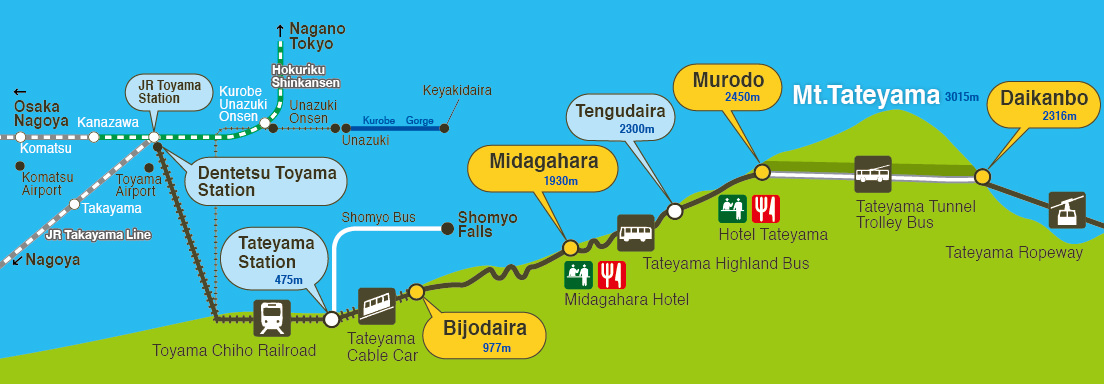
The Tateyama Kurobe Alpine Route is another popular tourist destination. But one that I was still excited to go visit – the snow wall. I have seen it quite a few times in travel brochures but now I will get to see and touch the real thing. While looking for info on the snow wall, I realized that the travel was going to be complicated, expensive and time consuming if one is planning to complete the entire route.
Travel map from alpen-route.com
If you are visiting just the snow wall, it would be a lot simpler. The snow wall is located at Murodo along the Tateyama Kurobe Alpine Route. If you are driving, you can park around Tateyama station. No, you cannot drive up to Murodo. From Tateyama, you would take a cable car to Bijodaira followed by a bus to Murodo. From Murodo station, you would be able to see and walk to the snow wall.
Snow wall at Tateyama Kurobe Alpine Route
I will cover this in more detail in my next
post. Do note that the Alpine route is only opened on a seasonal basis. So, do
check before making your trip there.
Day 6: Drive from Nagano to Mt. Fuji area
We spent most of the day driving from Nagano down to Mt. Fuji area. The one highlight for the day was the side trip to Daio Wasabi Farm (大王わさび農場), one of Japan’s largest wasabi farms. It is located in rural Azumino City near Matsumoto.
Daio Wasabi Farm
This is a huge farm, with rows and rows of
Wasabi plants getting clear flowing water from the Northern Alps.
We reached Mt. Fuji area towards the evening and
made our way to a popular noodle joint for dinner – Hoto Noodle Restaurant (甲州ほうとう 小作 河口湖店).
Hoto Noodle Restaurant
Day 7: Mt. Fuji Subaru Line 5th
Station and Mt. Fuji area
Finally, we were at the biggest attraction for this trip – Mt. Fuji. This was going to be our first time getting up close to Mt. Fuji and I was excited. We were lucky and got a hotel room with a view of Mt. Fuji through the window.
Right after breakfast at a Japanese chain, we drove to the Mt. Fuji Subaru Line 5th Station. It was rather crowded as this is a very popular tourist spot. As we were there early enough, we had no trouble finding a parking lot. This is probably the highest spot to Mt. Fuji that you can reach with a car. With kids in tow, we did not do any hiking but just toured the station and enjoyed the majestic view of Mt. Fuji.
Mt. Fuji Subaru Line 5th Station Map from Yamanashi Prefectural Doro Kosha Mt. Fuji Toll Road Administrative OfficeView of Mt. Fuji from Subaru Line 5th Station
Day 8: Shopping and departure out of Narita
We managed to squeeze some time for a quick shopping trip and lunch at Mitsui Outlet Park Makuhari, before making our way to Narita airport our flight. It is also located in Chiba prefecture, on the way to the airport.
As part of my Wakayama self drive trip, I made Nagoya my last stop. Nagoya (名古屋) is the largest city in the Chūbu region (中部地方) and third largest city in Japan. It is also the capital of Aichi prefecture (愛知県). Its main industry is manufacturing and is one of Japan’s major port.
Mt. Togoku Fruit Park (東谷山フルーツパーク, Tel: +81-52-736-3344, 2110 Aza Togoku, Oaza Kamishidami, Moriyama-ku, Nagoya) is a multipurpose agriculture park established in 1980. It is located to the northeast of Nagoya City.
Mt. Togoku Fruit Park area map
The park can be divided into 6 broad areas:
Map of Mt. Togoku Fruit Park (Picture from fruitpark.org)
1. Fruit Orchards
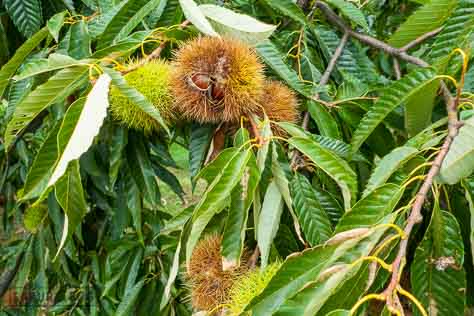
I would think this would be the main feature of the park. There are 15 orchards covering a space of roughly 22,340 m². These orchards are home to about 189 varieties of 963 fruit trees such as pear, plum, peach, apple, Japanese apricot, blueberry and persimmon.
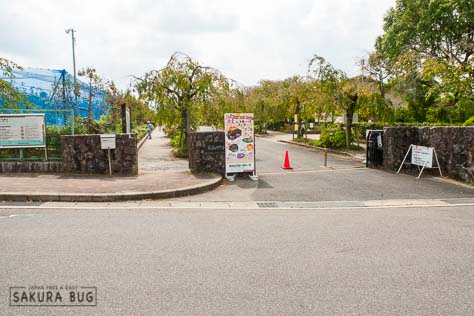
When you enter the park from the north entrance, where car park number 3 is, you will see the apple orchard on your left. The other bigger orchard area is to the far right.
North entrance of Mt. Togoku Fruit Park
The fruits harvested from the orchards are sold at the retail shop (3). Here are some pictures of the fruit trees in the orchards.
Fruit Orchard – Chestnut
Fruit Orchard – Apple
2. Green House
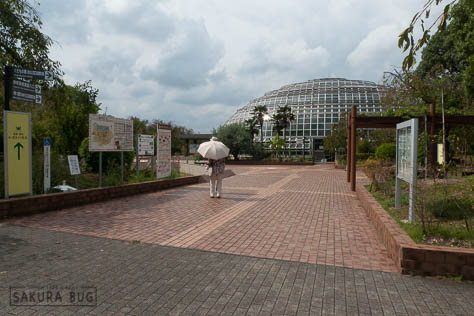
For cultivation of tropical fruits, there is a green house consisting of a large and small dome-shaped structure. Within the green house, there are tropical and subtropical fruit trees such as the banana, papaya, coconut, mango amongst others.
3. Retail Shop
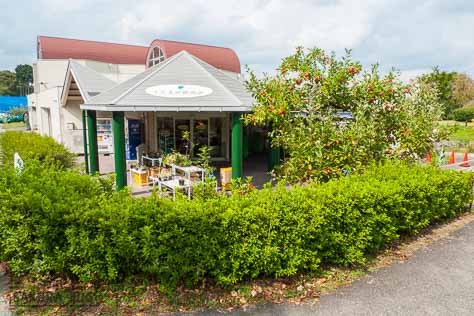
If you are looking to buy produce from the park, you could proceed to the retail shop which is located almost on the immediate right as you enter from the north entrance. The layout is much like a mini-mart.
4. Restaurant
If you are feeling thirsty or hungry after roaming through the park, there is a restaurant which can seat about 100 guests housed within the park. You can take a break here and enjoy a delicious meal along with seasonal fruits.
5. Fishing Corner
If you are looking for other outdoor activity, you might want to consider fishing. The fishing pond is near the south entrance, where car park number 1 is.
6. Walkway
And if you fancy a hike, there is a walking path from the fruit part to Mt. Togoku. The hike is rough 750m to the summit observatory and should take around 30 mins.
Have fun touring the park! I was there in summer. However, if you are there in spring, it is a popular spot for viewing the cherry blossoms.